
Murphy Resident Lookup Starting Points
Use a first result as a lead, then test it with a second custodian. The Collin Central Appraisal District search can tie an owner of record to a situs address, mailing address, parcel identifiers, legal description, tax year, and exemption context. It does not establish who occupies the parcel. The County Clerk’s deed index adds a dated grantor or grantee role, while a voter or court result answers a different question. A strong Murphy resident lookup records the source date and names the role shown rather than labeling someone a resident from one hit.
| Record | What It Confirms | Where | Access |
|---|---|---|---|
| CCAD parcel | Owner, situs, mailing and parcel facts | Collin CAD | Current/tax-year public search, updated nightly |
| Deed index | Parties, instrument date and legal description | County Clerk | Free index; image and copy routes vary |
| Voter registration | Registration search lead | Collin Elections | Name and DOB form; protected-voter limits |
| Court index | Party role, case type and docket status | County Judicial Records | Online coverage plus manual clerk research |
| Vital and probate | Family, death, estate, or certificate lead | DSHS and County Clerk | Eligibility and confidentiality rules apply |
When an address is the best known fact, begin with the CCAD parcel card. When a name is all that is known, compare spelling variants across the voter form and judicial index before considering a deed, vital index, probate matter, business filing, or license result.
Murphy Resident Roles Are Different
Myth: an owner, voter, court party, registrant, or license holder is automatically a Murphy resident. Each source describes a role at a particular time. An appraisal account may send notices to a trust, business, agent, or old mailing address. A court filing can name a party, attorney, witness, creditor, or former address. A state business filing may show a registered agent, and a professional license address can be stale or serve a licensing purpose.
Keep the CCAD situs address separate from its mailing field, then use the legal description or geographic ID to make sure a deed belongs to the same parcel. A voter record is registration evidence, not a promise of present occupancy. This role-by-role approach prevents a same-name result from becoming an unsupported resident claim.
Murphy Voter Lookup Fields
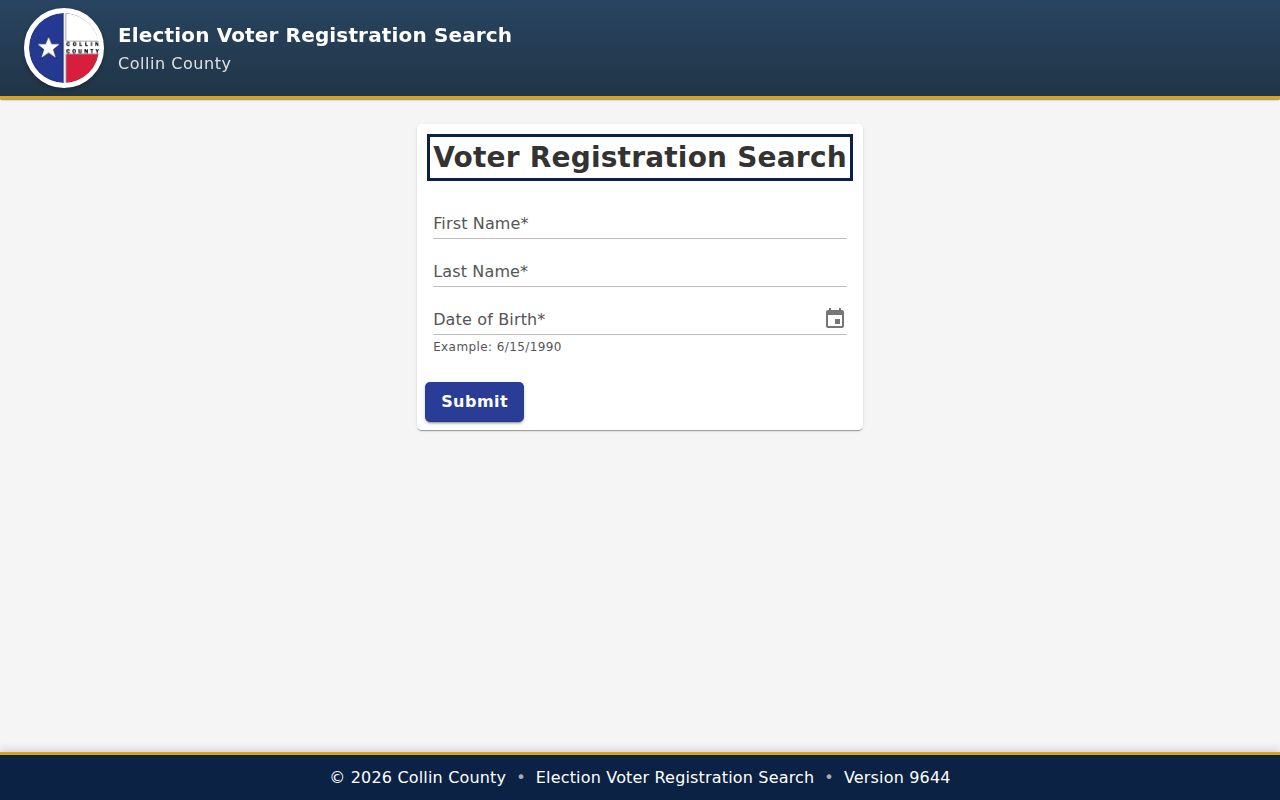
The free Collin County Voter Registration Search has fields for First Name, Last Name, and Date of Birth. It is a name-and-DOB route, not a street-browse tool. Ordinary voter data and purchased voter records have distinct public-field and protected-voter rules. Do not supply more birth-date detail than the search requires, and do not treat a missing ordinary result as proof that someone is not registered.
The county voter-registration form is shown below. Its three fields are useful for separating similar names, but the form is only one piece of a Murphy resident lookup.
Use any resulting registration lead alongside a parcel, deed, or dated court record. Texas protected voters can receive substitute addresses or redaction, and voter records do not reveal ballot choices.
Collin Elections also directs people to its voter-registration contact and statewide verification routes. A county form may not expose the same fields as an ordinary or purchased record, so record the exact source used and avoid treating a status field, precinct, or mailing detail as a substitute for an address verification.
Murphy Court Records by Year
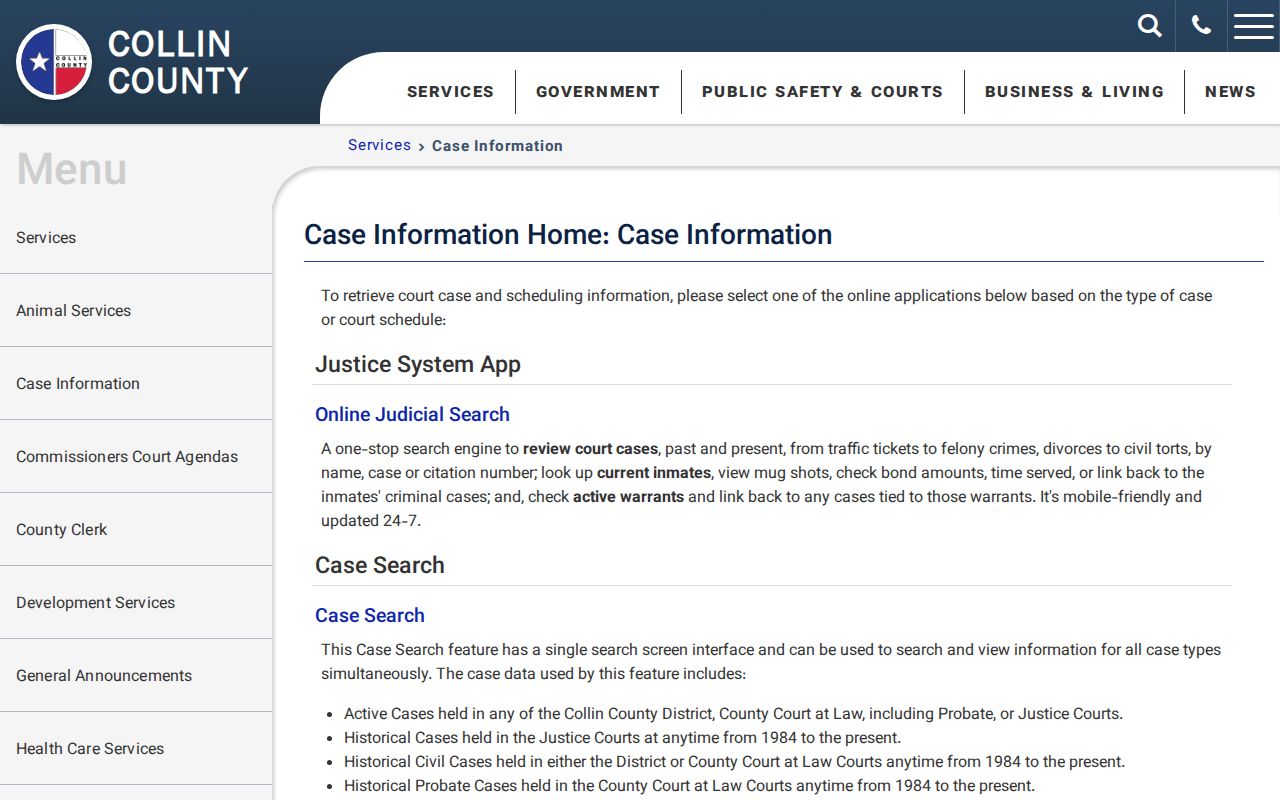
Collin County Case Information directs users to the county’s Judicial Records search, where a name or case/citation number can start a search. The county says Case Information updates daily, while its separate Case Record Inquiry is real-time for one case type. Historical online coverage begins in 1984 for justice, civil, and probate matters; district criminal begins in 1988 and county criminal in 2000. Earlier cases require a clerk’s manual research route.
The county’s case-information page documents the coverage split and search paths visible in this Murphy resident lookup reference.
A court result normally identifies the indexed party or style, case or citation number, court and case type, filing or citation date, events or hearings, and status or disposition where that category exposes it. That inventory is useful for sorting same-name results; it is not a criminal-history certification, and a docket hit is not a conviction.
| Party or style | The person’s role in the case, which may not be a residence role. |
|---|---|
| Case or citation number | The identifier needed for a clerk copy request. |
| Court and type | The division and subject path for the record. |
| Dates and events | Filing, citation, hearing, calendar, and status details where available. |
Verify a Murphy Resident Lookup
For a current public-record lead, use the same name and place across two or more sources. Start with the property account when an address is known. Save the property and geographic identifiers, but do not merge the situs and mailing fields. Then check the voter form only when the name and date-of-birth information are appropriate. A dated deed or court result can test whether the same person and parcel remain connected.
- Find the Murphy address in CCAD and note the owner/file-as name, situs, mailing field, property ID, geographic ID, and legal description.
- Search the County Clerk’s Official Public Records index for that name, then match the instrument’s legal description and recording date to the parcel.
- Use the county voter form or judicial search to distinguish name variants and compare dates, roles, and court categories.
- Ask the record custodian for a copy or certified document only when the exact case, instrument, or vital-record route is known.
- Docket
- A court’s running case record, including events and hearings where the court makes them visible.
- Index and image
- An index lists record details for searching; an image is the scanned document and may have different access or copy charges.
- Certified copy
- A custodian-issued copy bearing its certification, not the same thing as a search result or verification.
Murphy Vital Record Boundaries
Texas DSHS Vital Statistics handles statewide request procedures. Under Texas Government Code §552.115, births become public after 75 years and deaths after 25 years. Before those thresholds, certified copies require a qualified applicant or a direct and tangible interest. A marriage or divorce verification can confirm that a state record exists, but it is not the certificate or underlying court file.
For an adoption-related family search, the Central Adoption Registry is a voluntary matching program. Adult adoptees, birth parents, and biological siblings who are 18 or older may participate when the Texas birth or adoption relationship qualifies. A release requires a mutual match, consent, counseling, and a biography. The listed application fee is $30, with identification and name-change proof as applicable.
These access rules make vital material a confirmation route, not a shortcut to private family information.
Murphy Probate and Affiliation Trails
An heir search belongs with the County Clerk’s probate path. The county documents public computers for current probate matters and a paper-file appointment route; older probate work can require manual research. Estate, guardianship, will, notice, affidavit, and deed records may help connect a family question to a dated case, but sensitive or sealed material may not appear online.
Business, DBA, permit, and license entries can supply affiliation evidence only. SOSDirect is the Texas route for entity, assumed-name, UCC, copy, and certificate work, and uses an account with a stated $1 search fee. The Texas occupational-license gateway routes to separate boards. Registered-agent, principal-office, business, contractor, and license addresses should never be treated as home proof.
Note: A probate, business, or license result gains value only when its date and role align with independent Murphy records.
Murphy Lookup Clerk Fallbacks
When online coverage ends, request an existing record from the custodian instead of asking an agency to create a current-resident list. The Texas Public Information Act, Government Code chapter 552, governs requests for existing public information and allows exceptions and redactions. For district files, the Collin County District Clerk documents a written request route and manual searches for district criminal cases before 1988 and civil cases before 1984.
Collin County District Clerk
2100 Bloomdale Road, McKinney, TX 75071
Monday through Friday, 8 a.m. to 4:30 p.m.
972-548-4106
dcrecords@co.collin.tx.us
The clerk states that a manual request needs the full name and date of birth, a self-addressed stamped envelope, and payment. Its published details include a $5 search, stated copy charges, and separate forms per case. The county’s normal response statement does not mean every file is online or releasable.
County Court at Law history follows another clerk route for criminal matters before 2000 and civil matters before 1984. Probate research can use courthouse public computers or a paper-file appointment. A specific record request should name the person, date range, case or record type, and the custodian that holds it, while leaving any protected details to the office’s review.
Murphy Resident Lookup Privacy
Protected voters, Address Confidentiality Program participants, juveniles, sealed or expunged court material, adoption information, protected-victim records, and some medical or family-law details can be absent or redacted. Driver-license data is not a public address search. Texas law also permits agencies to withhold confidential fields while producing the portions that are public. A no-result may reflect an access limit, a name variation, a historical gap, or no matching record.
Commercial people-search categories can combine stale address histories and mismatched same-name data. Official parcel, clerk, court, and state sources remain the better way to verify a particular record. For a whole-address trail rather than one-person verification, the Murphy by-street directory follows the address route.
Lawful use. Use Murphy resident lookup records for personal, lawful research and protect sensitive details. Texas Penal Code §§42.072 and 42.07 address stalking and harassment; do not use records to monitor, intimidate, or harm anyone.